ProductNo:KH10.ST
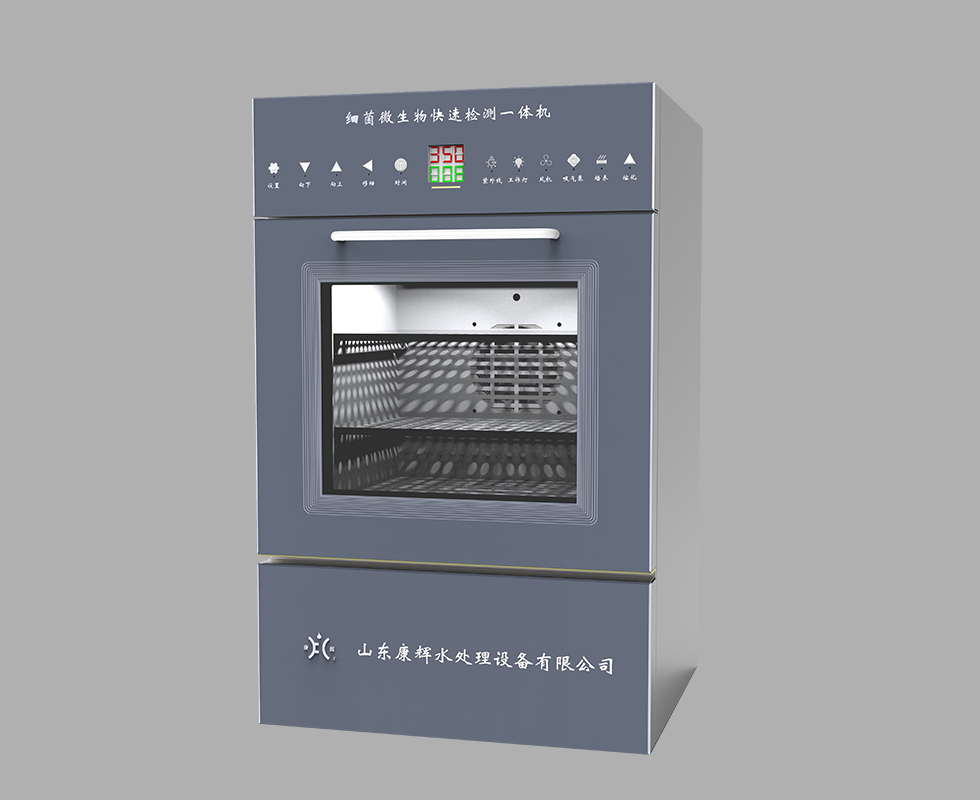
Product Name:Microbial detection integrated machine KH10.ST
Product Size:KH10.ST
Description:
Introduction
According to section 5.3.11 of the Chinese health industry standard WS507-2016 "Technical Specification for Cleaning and Disinfection of Soft Endoscopes", purified water should comply with the provisions of GB5749 and ensure that the total number of bacteria is ≤ 10CFU/100ml; The pore size of the filter membrane used for producing purified water should be ≤ 0.2 μ m and should be replaced regularly. Aseptic water refers to water that has undergone sterilization processes, and microbiological testing may be performed on purified or sterile water when necessary.
According to the requirements of Appendix A Sampling and Inspection Methods A.1.3 of the National Standard GB15982-2012 "Hospital Disinfection and Hygiene Standards" of the People's Republic of China, validated on-site rapid detection instruments can be used to monitor and screen for microbial contamination of the environment, object surfaces, and cleanliness of medical devices; It can also be used for checking the effectiveness of hospital cleaning and evaluating and certifying cleaning procedures. According to Appendix A Sampling and Inspection Methods A.5.3.3 Requirements for Disinfected Endoscopes: Take the cleaned and disinfected endoscope, use a sterile syringe to extract 50ml of eluent containing the corresponding neutralizing agent, inject it into the flushing endoscope tube from the biopsy port, and collect the full amount (which can be collected using a peristaltic pump) for testing. Mix the eluent thoroughly, take 1ml of eluent and inoculate it into a petri dish. Pour 15ml to 20ml of melted nutrient agar medium cooled to 40-45 ℃ into each dish, incubate in a 36 ℃± 1 ℃ constant temperature incubator for 48 hours, and count the number of colonies (cfu/piece). Concentrate the remaining eluent under sterile conditions using a filter membrane (0.45 μ m), inoculate the filter membrane onto a solidified nutrient agar plate (be careful not to produce bubbles), incubate in a 36 ℃± 1 ℃ constant temperature incubator for 48 hours, and count the number of bacterial colonies.
Nowadays, the testing of endoscopic instruments in hospitals requires on-site sampling and then submission to the laboratory for inspection and cultivation, which is labor-intensive and time-consuming. It is impossible to determine whether the testing instruments meet the usage requirements in the shortest possible time. The detection of water used for endoscopic cleaning or hemodialysis cannot meet the requirement of detecting the total number of bacteria in 100ml due to the existing testing conditions in the hospital. Therefore, the method of sampling 1ml to detect the total number of bacteria is used. Therefore, the detection standards are too strict and cannot truly reflect the standard requirement of detecting the total number of bacteria in 100ml. The detection work cannot be completed quickly and conveniently on site. Our company has developed a microbial monitoring all-in-one machine based on the requirements of the national regulations mentioned above and combined with the actual situation of the endoscopy room and hemodialysis room.
This device can be used for the detection and cultivation of bacterial counts in endoscopic instruments and endoscopic cleaning water. The device is versatile and can replace endoscopic sampling pumps and microbiological testing equipment. It can be used in conjunction with endoscopic sampling devices to achieve on-site sampling and cultivation of endoscopic microorganisms, and can also be used in conjunction with sand core filters to achieve sampling and cultivation of endoscopic cleaning water. It can perform disinfection experiments on testing vessels, as well as bacterial cultivation and detection. It is a multifunctional device that integrates sterile workbench, disinfection cabinet, endoscopic testing sampling pump, microbiological testing equipment, constant temperature box, and bacterial detection functions.
This device adopts multiple control methods, is easy to operate, safe and reliable, and can provide on-site detection solutions for endoscopic microorganisms and endoscopic cleaning water. It can meet multiple needs for water sample detection such as endoscopic cleaning water machines, hemodialysis water, oral cleaning water, etc. Equipped with high-precision temperature sensors for precise control; UV disinfection has strong penetration for sterilization; Built in lighting device; It can achieve the advantages of independent operation by one person and obtain test results in the shortest possible time, fully meeting the requirements of the health industry standard WS507-2016 and the national standard GB15982-2012.
This microbial monitoring all-in-one machine can reduce a lot of workflow, meet the needs of rapid on-site testing, have the shortest detection result time, and maximize the clinical safety of the testing equipment.
2、 Technical parameters:
1. Power requirement: AC220V/50Hz
2. Temperature range: Room temperature+5 ℃~60 ℃
3. Disinfection method: UV disinfection
4. Vacuum pump flow rate: 1.5L~3L/min
5. Bacterial culture temperature: 25 ℃~42 ℃ (different water samples at different temperatures)
6. Temperature fluctuation: ≤± 0.5 ℃
7. Product power: 500w/150w
8. Product size: 420x370x660/500x270x300 (mm)
9. Capacity: 20L/7L
3、 Performance characteristics:
1. High brightness digital display, controlled by a microcontroller;
2. Intelligent temperature control system, supporting setting and adjustment;
3. High precision temperature sensor for precise temperature control;
4. Built in vacuum device to ensure stable suction;
5. UV disinfection has strong penetration and is safe and reliable;
6. High quality stainless steel inner liner and shelves, resistant to high temperatures and corrosion;
7. The studio is equipped with LED lighting sources for convenient user operation
8. Built in endoscopic detection and microbiological testing functions.
4、 Scope of use:
1. Rapid detection and cultivation of bacteria and microorganisms in endoscopic instruments;
2. Rapid detection and cultivation of bacteria and microorganisms in endoscopic cleaning water;
3. Rapid detection and cultivation of bacteria and microorganisms in hemodialysis water;
4. Rapid detection and cultivation of bacteria and microorganisms in oral water;
5. Rapid detection and cultivation of bacteria and microorganisms in animal experimental water.