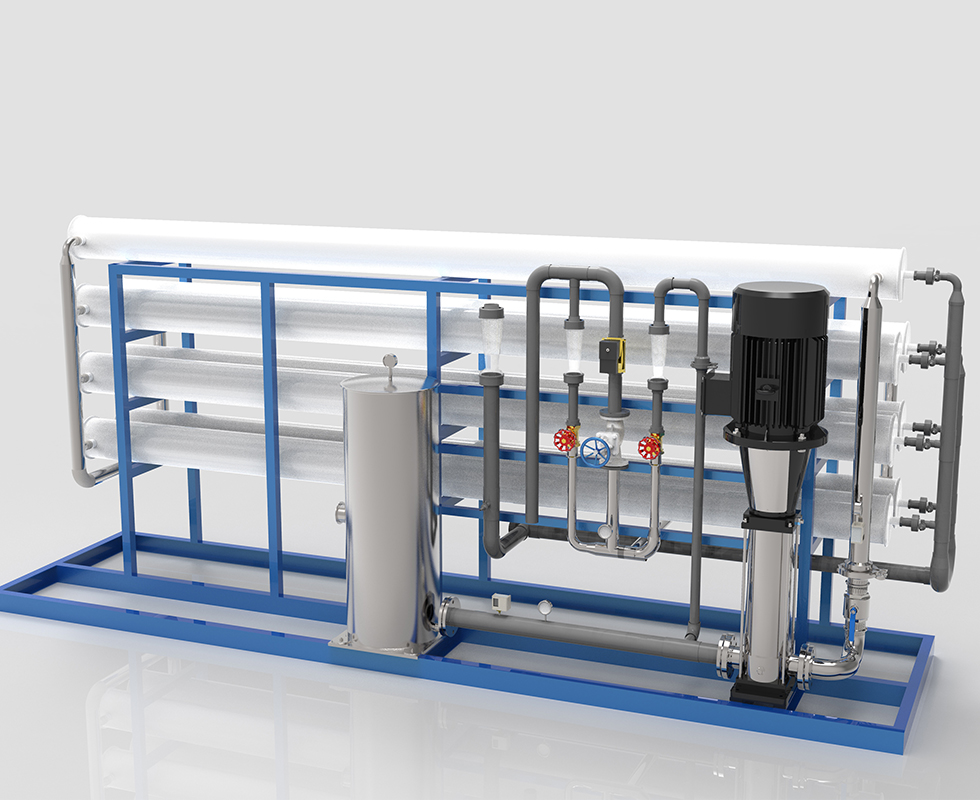
ProductNo:KH8.SWRO
Product Name:KH8.SWRO series seawater desalination device
Product Size:KH8.SWRO
Description:
Introduction
1. Basic principles
Reverse Osmosis (RO) seawater desalination is a desalination process based on membrane separation technology. The core principle is to drive seawater through a semi permeable membrane under high pressure, and use the membrane's microporous structure (pore size of about 0.1 nanometers) to selectively intercept salt, heavy metals, and impurities, allowing only water molecules to pass through, thereby achieving seawater desalination. This process has low energy consumption (about 3-6 kWh/m ³) and a desalination rate of over 99%, making it one of the mainstream seawater desalination technologies currently available.
2. System composition
Reverse osmosis devices typically consist of the following modules:
(1) Pre treatment system: including multi-stage filtration (sand filtration, activated carbon filtration) and sterilization device, to remove suspended solids, algae, and large particle impurities, and protect subsequent membrane components.
(2) High pressure pump: Provides 4-8 MPa pressure, overcomes seawater osmotic pressure (approximately 2.5 MPa), and drives water flow through the RO membrane.
(3) Membrane module: The core unit is composed of spiral wound or hollow fiber RO membranes stacked to achieve saltwater classification and separation.
(4) Post treatment system: Adjust the pH, mineralize or disinfect the produced water with ultraviolet radiation to ensure that the water quality meets drinking or industrial standards.
(5) Energy recovery device (optional): recovers the residual pressure of concentrated saltwater through pressure exchange technology, reducing energy consumption by 30% -40%.
3. Technical advantages
(1) Energy saving and efficient: Compared with distillation method, energy consumption is reduced by more than 60%, and daily water production meets the needs of users of different scales.
(2) Stable water quality: Total dissolved solids (TDS) in the produced water is ≤ 500 ppm, meeting the hygiene standards for drinking water.
(3) Modular design: The device is compact and can be flexibly expanded, suitable for different scale requirements.
(4) Environmental friendliness: The discharge of concentrated salt water is reduced compared to traditional processes, and the ecological impact can be reduced through dilution or mixed discharge.
4. Application scenarios
(1) Coastal water scarce cities, such as seawater desalination plants, solve the problem of freshwater scarcity.
(2) Industrial water: Provide pure water for high water consuming industries such as electricity, petrochemicals, and electronics.
(3) Islands and ships: Small RO devices are used for independent water supply systems in off grid areas.
(4) Emergency relief: Quickly deploy mobile devices to respond to sudden water shortage crises.
Reverse osmosis seawater desalination technology has become a key solution to the global water crisis due to its high efficiency and flexibility. Continuous technological iteration will further promote its application in sustainable water resource management.